
The question
Mei Ling invests RM 8000 in a savings account. The account pays compound interest at a rate of per year.
(a) Calculate the amount in the account at the end of 4 years. Give your answer correct to the nearest sen. [2 marks]
(b) Calculate the total interest Mei Ling earns in these 4 years. [1 mark]
(c) Find the smallest number of complete years after which the amount in the account is more than RM 10 000. [2 marks]
The common wrong answer
Many students work out one year’s interest and then multiply it by the number of years:
So they write RM 9120 for (a) and RM 1120 for (b).
For part (c) they need the amount to grow by , so they divide by 280:
and round up to 8 years.
This is simple interest. It assumes the interest every year is RM 280, worked out on the original RM 8000. But with compound interest, each year’s interest is added to the account, and the next year’s is worked out on the new, larger amount. The interest grows every year, so the simple-interest working gives too little money in (a) and (b), and too many years in (c). Cambridge examiner reports describe exactly this: candidates using the simple-interest method, or simple depreciation, when the question is about a compound process.
The correct working
(a) Adding to an amount is the same as multiplying it by
Each year the amount is multiplied by again, so after 4 years:
So the amount after 4 years is RM 9180.18.
(b) The interest is the amount minus the money originally invested:
So the total interest is RM 1180.18.
(c) Keep multiplying by and check each year against RM 10 000:
So the amount first goes over RM 10 000 after 7 years.
Show both lines in the exam: the year just below RM 10 000 and the year just above it. That proves 7 is the smallest number of years.
Why it works
With simple interest the account grows by the same amount, RM 280, every year. With compound interest it grows by the same percentage every year, and of a bigger number is a bigger number. In year 1 the interest is RM 280, but in year 2 it is of RM 8280, which is RM 289.80, and by year 7 it is over RM 340.
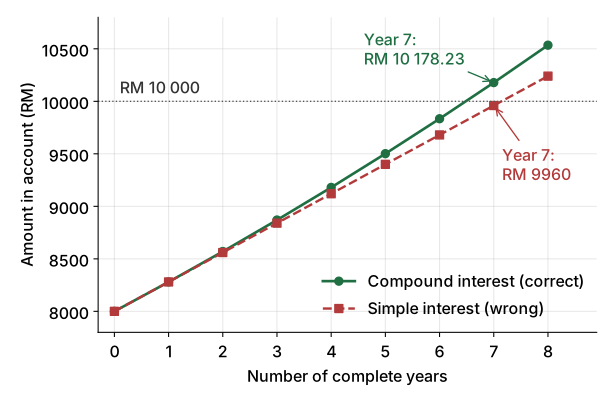
The gap is small at first, only RM 60.18 after 4 years. That is exactly why the wrong method is tempting: the answer looks reasonable. But in part (c) the difference decides the answer, because after 7 years the simple-interest method gives RM 9960, just short of RM 10 000, while the real account has RM 10 178.23.
Writing the multiplier, , also gives you a quick general rule: after years the amount is . You don’t need to work through the years one at a time, and there is no formula sheet, so it’s worth knowing how to build this yourself.
How to spot it next time
- Read the word in front of “interest”. Compound means the multiplier is raised to a power: . Only simple interest is the same every year.
- Check what is being asked for: the amount in the account (interest included) or just the interest. Subtract the original sum only for the interest.
- For “how many years”, test whole numbers of years and write down the year either side of the target value.