
The question
A group of 60 Form 4 students was asked about two clubs.
It is given that , and . There are 8 students who belong to neither club.
(a) Find the value of . [3 marks]
(b) Find the number of students who belong to exactly one of the two clubs. [2 marks]
(Cambridge papers write the universal set as rather than . It means the same thing.)
The common wrong answer
The student draws two overlapping circles, writes in the overlap and outside, which is right. Then they copy the set totals straight into the outer parts of the circles: in “ only” and in “ only”. Adding the four regions:
For part (b) they add the two outer regions: .
The error is in the first step. counts everyone in the robotics club, including the students who are also in debate. Writing in the “ only” part counts those students twice.
The four regions do add to 60, so the mistake hides well. Check the circle instead: with , the whole of circle holds students, but . The diagram contradicts the question.
Cambridge examiner reports describe exactly this error: candidates writing a set’s total in the outer part of its circle instead of subtracting the overlap, and writing the totals into the regions without understanding what each region represents.
The correct working
(a) Start from the overlap and the outside, which you are given directly. Then work out the “only” parts by subtracting the overlap from each set total:
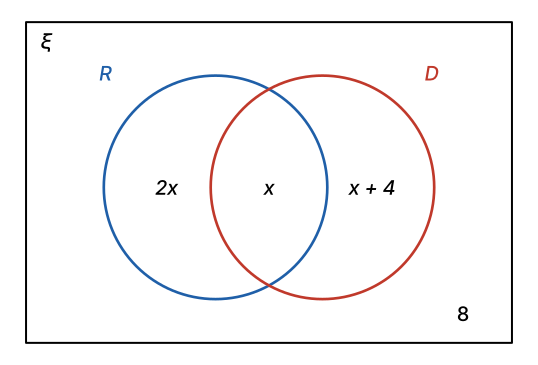
The four regions together make up all 60 students:
So .
Check the circles: holds ✓ and holds ✓.
(b) “Exactly one club” means only or only, not the overlap:
So 40 students belong to exactly one club.
Why it works
Each region of a Venn diagram is a separate group of people, and every person is counted in exactly one region. The overlap is the group in both clubs, so it is part of circle and part of circle . A total like is the whole circle, the outer part plus the overlap, so the outer part is what’s left after you take the overlap away.
That’s also why the equation works. Once every region holds a separate group, adding the four regions counts each of the 60 students once. It’s the same idea as the formula : here students are in at least one club, and ✓.
How to spot it next time
- Fill a Venn diagram from the inside out: the overlap first, then the outside, then the “only” parts by subtracting.
- Read as “the whole circle ”, never as “ only”.
- When you have an answer, add up each whole circle and check it matches the total you were given, not just the grand total.