
The question
Two ice skaters move towards each other in a straight line on a smooth, level rink. Skater A has a mass of 60 kg and moves to the right at 3.0 m/s. Skater B has a mass of 40 kg and moves to the left at 2.0 m/s. When they meet, they grab hold of each other and move off together. Friction from the ice can be ignored.
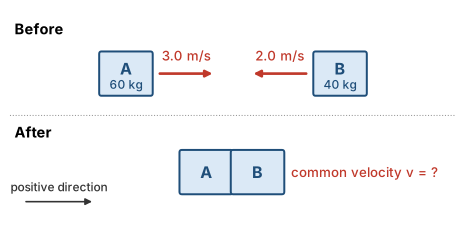
(a) Calculate the velocity of the two skaters just after they grab hold of each other. State its direction. [3 marks]
(b) The grab lasts 0.40 s. Calculate the average force exerted on skater B during the grab. [3 marks]
Cambridge IGCSE note: momentum, impulse and conservation of momentum are Extended (Supplement) content in 0625.
The common wrong answer
Most students write “momentum before = momentum after” and add the two momenta as if they were plain numbers:
Students who do get 1.0 m/s in part (a) can still lose part (b) the same way, by working out skater B’s change in momentum from the speeds alone:
Both answers are wrong for the same reason. Momentum is a vector: it has a direction. The skaters are moving in opposite directions, so their momenta partly cancel. Skater B’s 80 kg m/s points to the left and must be written as .
The answer to (a) should also ring an alarm bell. It gives a total momentum after the grab of kg m/s, more than skater A had alone (180 kg m/s), even though skater B was moving against A. The June 2024 Cambridge 0625 examiner report describes exactly this: on a change-of-momentum question, most candidates did not notice that the two velocities were in opposite directions, so the momenta were too.
The correct working
(a) Take to the right as positive. Skater B moves to the left, so B’s velocity is m/s.
Momentum before the grab:
Total momentum before .
After the grab, both skaters move together with velocity , so the total mass is kg. By conservation of momentum:
The answer is positive, so the skaters move at 1.0 m/s to the right (in skater A’s original direction).
(b) Force is the change in momentum divided by the time taken, so first find skater B’s change in momentum, keeping the signs:
Skater B is first stopped and then sent back the other way, which is why the change is so large.
The average force on skater B is 300 N to the right.
Check with skater A: A’s change in momentum is kg m/s, so the force on A is N, which is 300 N to the left. Equal and opposite, as Newton’s third law says it must be.
Why it works
Momentum is mass times velocity, and velocity includes direction. In one dimension we show direction with a sign: choose one direction as positive, and anything moving the other way gets a negative velocity, and so a negative momentum.
Conservation of momentum says the total momentum stays the same when no external force acts. Here, A’s 180 kg m/s to the right and B’s 80 kg m/s to the left combine to a total of 100 kg m/s to the right. That total is shared by 100 kg after the grab, giving 1.0 m/s.
The same idea matters for the force. Going from 2.0 m/s left to 1.0 m/s right is a change in velocity of 3.0 m/s, not 1.0 m/s, because skater B has to stop first and then speed up the other way.
How to spot it next time
- Before writing any momentum equation, mark a positive direction on the diagram and give every velocity a sign, including your answer for the velocity after.
- If objects move towards each other, their momenta subtract, so the total must be smaller than the larger of the two momenta. If yours is bigger, a sign is missing.
- For a change in momentum, use final minus initial with signs. When an object reverses direction, the speeds add.