
The question
A student uses a detector and counter to investigate a radioactive sample.
With the sample removed, the counter records a background count rate of counts/min.
The sample is then placed in front of the detector. At time , the measured count rate is counts/min. The half-life of the isotope in the sample is hours.
(a) Calculate the count rate the student will measure at hours. [3 marks]
(b) Calculate the time at which the measured count rate will be counts/min. [3 marks]
Cambridge IGCSE note: correcting count rates for background radiation, and half-life calculations that include it, are Extended content in 0625.
The common wrong answer
Most students spot that hours is half-lives and halve the reading three times:
“The measured count rate is counts/min.”
The mistake is halving . The detector is counting two things at once: radiation from the sample and background radiation from the surroundings (rocks, buildings, radon in the air, cosmic rays). Only the part from the sample halves every hours. The background stays at about counts/min whatever the sample does.
A second slip is to subtract the background at the start, halve correctly to get , and then stop. That is the count rate from the sample alone, but the question asks what the student will measure, and the detector still picks up the background. Cambridge examiners reported both of these errors on a multiple-choice question of this type in 2024.
Part (b) shows the problem even more clearly. Halving gives , , , , so it never lands on , and students end up guessing a time between and half-lives.
The correct working
(a) Subtract the background to get the count rate from the sample alone (the corrected count rate):
Number of half-lives in hours:
Halve the corrected count rate three times:
The detector also picks up the background, so add it back on:
The measured count rate at hours is counts/min.
(b) A measured count rate of counts/min means the sample itself is giving
Now count the halvings from down to :
That is half-lives:
The measured count rate is counts/min at hours.
Why it works
Half-life is about the nuclei in the sample: every hours, half of the undecayed nuclei that are left decay, so the count rate from the sample halves. The background has nothing to do with the sample, so it doesn’t halve.
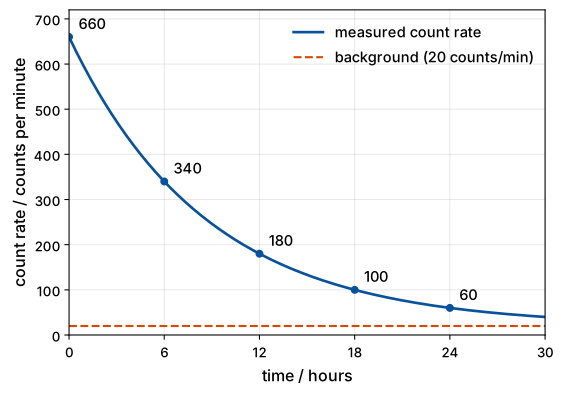
The graph makes this easy to see. The measured readings go , , , , . None of these is half of the one before, because each one has an extra on top. Take the off and you get , , , , , which halve perfectly. And however long you wait, the measured count rate never falls below about counts/min: it levels off at the background, not at zero.
So the method is always: subtract the background, halve, then add the background back if the question asks for what the detector reads.
How to spot it next time
- If a question gives a background count rate, it is there for a reason. Write “corrected count rate = measured − background” as your first line.
- Check the wording of the answer: “count rate from the sample” means corrected; “measured” or “recorded” count rate means add the background back on.
- If halving the readings never lands on the number you need, that is a sign you have forgotten the background.