
Most students I meet revise the same way: open the textbook or notes, read them again, maybe highlight a few lines, and close the book feeling ready. Then the test comes, and half of it has gone. The problem usually isn’t effort. It’s that rereading makes the material look familiar without making you able to produce it on a blank exam paper.
Two methods from learning research fix this, and they work well together:
- Retrieval practice: bringing what you’ve learned back to mind from memory, instead of reading it again.
- Spaced practice: spreading your reviews of a topic out over days and weeks, instead of cramming it all the night before.
Neither needs special apps or extra hours. They change how you use the time you already spend.
The method, step by step
1. Learn the topic as normal
Go to class, follow the lesson, do the homework. This is Day 0 for that topic. Write the topic name and date in a small revision list (a notebook page or a note on your phone is enough).
2. Close the book and brain-dump
The next day, take a blank sheet of paper. Without looking at anything, write down everything you can remember about the topic: definitions, formulae, the steps of the method, a sketch, an example. Give yourself about 10 minutes.
This will feel harder and slower than rereading. That’s the point: the effort of pulling it out of memory is what makes it stick.
3. Check it against your notes, in a different colour
Now open your notes and compare. Using a different colour pen, add what you missed and correct anything wrong. The gaps in the second colour are exactly what you need to work on. Without this check, you could be practising mistakes.
4. Answer two or three questions from memory
A brain-dump shows you know the facts; questions show you can use them. Do two or three short questions on the topic, from the textbook or past-year papers, with your notes closed. Mark them straight away.
5. Space out the next reviews
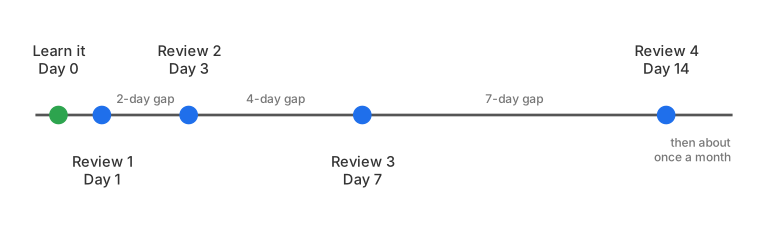
Repeat steps 2 to 4 on the same topic after about 1 day, 3 days, 1 week and 2 weeks, then roughly once a month until the exam. Each review usually gets quicker as the topic sticks. Don’t worry about hitting the exact day; what matters is that the gaps get longer and you never leave a topic untouched for months.
6. Mix topics once you have a few
When you have three or four topics in rotation, mix their questions in one session instead of doing them in blocks. In maths and physics especially, part of the exam is recognising which method a question needs, and mixed practice trains exactly that.
Example: a two-week timetable
Say a student learns three new topics in a week: A (Quadratic functions), B (Heat, in Physics) and C (Indices and logarithms). Each review session is 15 to 20 minutes, on top of normal homework.
| Day | Session |
|---|---|
| Mon | Learn A in class |
| Tue | Review A (brain-dump + 2 questions) |
| Wed | Learn B in class |
| Thu | Review A, review B |
| Fri | Learn C in class |
| Sat | Review B, review C |
| Sun | Rest |
| Mon (week 2) | Review A, review C |
| Wed (week 2) | Review B |
| Fri (week 2) | Review C |
Then A, B and C join the two-week and monthly reviews, and new topics enter the list as they’re taught.
Here’s what a quick brain-dump for topic A might look like on Tuesday:
Quadratic . If , the graph has a minimum; if , a maximum. Axis of symmetry . Roots from . Example: has axis , minimum point and roots and .
Then the student checks it against the notes, and adds in a second colour anything they missed, such as “the -intercept is , here ”.
Common mistakes
- Peeking. Glancing at the notes “just to get started” turns retrieval back into rereading. Write what you can, even if it’s only three lines.
- Skipping the check. A brain-dump you never compare with your notes can lock in a wrong formula. Always do step 3.
- Only reviewing the topics you like. The topics you avoid are usually the ones with the biggest gaps. Your revision list decides what’s due, not your mood.
- Making flashcards too long. If you use flashcards, keep one question per card, and say or write the answer before you flip it.
- Expecting it to feel easy. Spaced reviews feel harder than cramming because you’ve partly forgotten the topic. That struggle to remember is the work, not a sign the method isn’t working.
- Starting in the final month. Spacing needs time. Start with whatever you’re learning in class now, rather than waiting for the exam season.
A note for parents
You don’t need to know the subject to help. Ask your child to explain a topic they learned this week without their book open, then let them check it themselves. A few minutes of this at dinner is a retrieval session.
Try this
Tonight, pick the last topic you learned in maths or physics. Take a blank sheet, set a 10-minute timer and write everything you remember. Check it in a different colour, then write “Day 3” and “Day 7” with the dates in your planner so you know when to test yourself on it again.