
Quadratic functions come up again and again in SPM, and most questions ask for the same few things: the shape of the graph, the axis of symmetry, the maximum or minimum point, and where the graph cuts the axes. Once you have a fixed method, these become very manageable marks.
The 4-step method
For any quadratic function :
- Shape. If the graph opens upwards and has a minimum point. If it opens downwards and has a maximum point.
- Axis of symmetry.
- Vertex (turning point). Substitute that back into to get the -coordinate. This is the minimum or maximum value.
- Intercepts. The -intercept is . The -intercepts (roots) come from solving .
Worked example
Sketch the graph of .
- Shape: , so the graph opens upwards and has a minimum point.
- Axis of symmetry: , so .
- Vertex: , so the minimum point is .
- -intercept: , so the graph passes through .
- Roots: , so or .
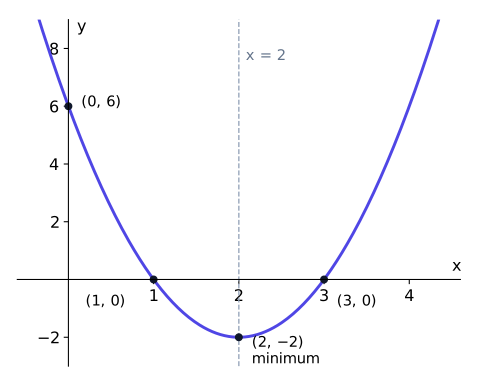
The sketch of with every calculated point labelled.
Quick check: the roots 1 and 3 sit equally either side of the axis . If your roots aren’t symmetric about your axis, something has gone wrong.
4 mistakes that cost marks
1. Getting the sign of wrong
In , is , not 8. Students who use get for the axis, which puts the whole graph in the wrong place. Always write down , and with their signs before you start.
2. Dropping the common factor
, not . The roots are the same either way, but if you later use the factorised form to find the -intercept or the vertex, you’ll be out by a factor of 2.
3. Completing the square without the coefficient of
To write the function in vertex form, take the 2 out first:
The vertex form gives the vertex , which matches our answer above. A common slip is writing instead of .
4. A sketch with missing labels
In a sketch question, marks are usually given for the shape, the turning point and the intercepts. A neat curve with no coordinates written on it can lose most of the marks. Label every point you’ve calculated.
Practise it
Try these with the 4-step method, then check that your roots are symmetric about the axis:
Answers
- Minimum point , roots and , -intercept 5.
- Maximum point , roots and , -intercept 5.
- Minimum point , roots and , -intercept .