Area Under a Curve: When Part of It Is Below the x-Axis
By Adrian Wong · 20 October 2026
The question
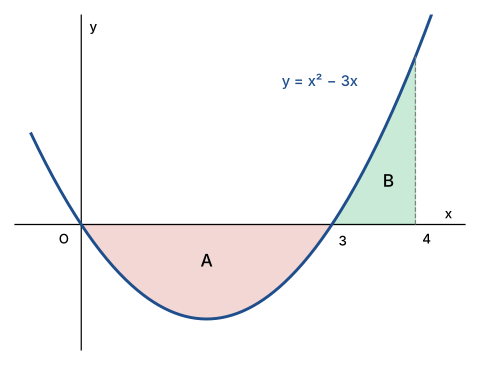
The diagram shows part of the curve y=x2−3x, which passes through the origin O. Region A lies between the curve and the x-axis. Region B is bounded by the curve, the x-axis and the line x=4.
Region A is below the x-axis; region B is above it.
(a) Show that the curve meets the x-axis again at x=3. [1 mark]
(b) Find the total area of the shaded regions A and B. [4 marks]
The common wrong answer
Most students integrate from 0 to 4 in one step:
∫04(x2−3x)dx=[3x3−23x2]04=364−24=−38
Then they see the minus sign, decide an area can’t be negative, and write "area=38units2".
The integration itself is correct. The mistake is assuming the integral is the area. Region A is below the x-axis, so the integral counts it as negative, and it cancels out most of region B. Removing the minus sign at the end doesn’t undo that cancellation, so 38 is wrong.
The correct working
(a) Set y=0:
x2−3x=0⇒x(x−3)=0⇒x=0orx=3
So the curve meets the x-axis again at x=3, as shown.
(b) Split the integral at x=3. Using ∫(x2−3x)dx=3x3−23x2:
Region A (from 0 to 3):
∫03(x2−3x)dx=(327−227)−0=9−13.5=−29
The negative sign just tells you the region is below the x-axis. Area of A=29units2.
So the total area is 319units2 (about 6.33units2).
Why it works
An integral adds up y×(a small width) across the interval. Where the curve is below the x-axis, y is negative, so that part adds a negative amount. The single integral from 0 to 4 is really
(−29)+(611)=−38
which is the area above the axis minus the area below it. An area is always positive, so you have to work out each piece on its own, make each one positive, and then add them.
How to spot it next time
Before integrating for an area, find where the curve crosses the x-axis inside your limits. If it crosses, split the integral at that point.
Sketch the curve, even roughly. If any part of the region is below the axis, expect a negative integral for that part.
Check against your sketch: here region A is clearly bigger than region B, yet 38 is smaller than the area of A on its own (29). An answer like that should make you look again.
Want help with this every week?
Join an online group class with Adrian at RM50/hr and a fixed weekly time, or request a free 1-on-1 trial lesson.