
The question
A container is a right circular cone with its vertex at the bottom and its axis vertical. The cone has height and the radius of its open top is . Water is poured in. When the depth of the water is , the radius of the water surface is and the volume of water is .
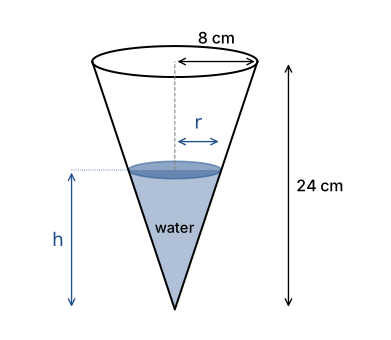
(a) Show that . [3 marks]
Water is poured in at a constant rate of per second.
(b) Find the rate at which the depth of the water is increasing at the instant when . [4 marks]
(c) Find the rate at which the radius of the water surface is increasing at the same instant. [2 marks]
[The volume of a cone is .]
The common wrong answer
This is the working I see most often for part (b). The student starts from the cone formula as given, with both and still in it:
Then they differentiate with respect to , treating like a number:
At the water surface has radius , so
Every line looks reasonable, but the second line is wrong. As the water rises, the surface gets wider, so is not a constant: it changes whenever changes. Differentiating as if stays fixed misses part of the change in volume, and the answer comes out three times too big.
A second trap is in the chain rule itself: writing . With the correct this gives , which would raise the water through the whole height of the cone in well under a second.
The correct working
(a) The water forms a smaller cone with the same shape as the container. By similar triangles,
Substitute into the volume formula, so that depends on only:
as required.
(b) Differentiate with respect to :
When :
Now use the chain rule. We know and want :
So the depth is increasing at .
(c) Since , we have , so
So the radius is increasing at .
Why it works
To differentiate with respect to , must be written in terms of only. Any other letter left in the formula has to be a genuine constant. The radius of the water surface isn’t: the deeper the water, the wider the surface. Similar triangles give the link , and substituting it turns into a function of one variable, .
You can see where the factor of comes from. Treating as fixed gives . Writing in terms of first gives a cube, , and the power rule brings down a : . The difference is the extra volume that comes from the surface getting wider.
For the chain rule, write it so the “cancels”: . Then rearrange for the rate you want. Examiners have noted that candidates who don’t first express the quantity in terms of a single variable struggle to make much progress on these questions, even when they know the chain rule.
How to spot it next time
- Before differentiating, look at your formula: if it has two variables that both change (here and ), use the shape (similar triangles, a given ratio) to remove one of them first.
- Write the chain rule out in full with the rates in the right places, then substitute. Check the units: divided by gives .
- Sense-check the size. The water surface at has area , and flows in each second, so the level should rise by roughly per second, not .