
The question
The straight line , where is a constant, does not meet the curve .
Find the range of values of . [4 marks]
The common wrong answer
Most students set up the algebra correctly. Where the line and curve meet, the -values are equal:
The line doesn’t meet the curve, so this equation has no real roots, and with , , :
So far, so good. The critical values are and . Then the final line goes wrong:
This is the region where is positive, the opposite of what the inequality asks for. A quick test shows it can’t be right: is in this “answer”, but with the equation becomes , whose discriminant is . The line cuts the curve twice.
It usually happens when the region is chosen from memory instead of from a sketch. Cambridge’s examiners have noted that candidates who link a quadratic inequality to a sketch of its graph are more often successful.
The correct working
Equate the line and the curve and rearrange so one side is zero:
The line does not meet the curve, so this quadratic has no real roots:
Substitute , , :
The critical values are and . Sketch against : a U-shaped curve crossing the axis at and .
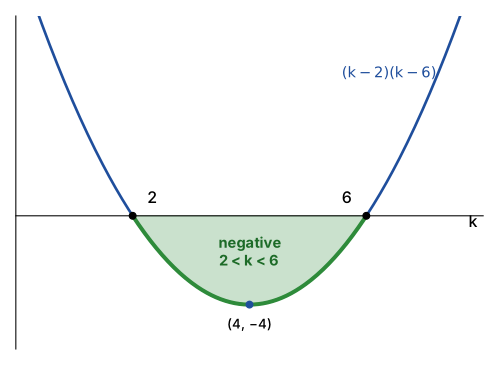
We need the part below the axis, which is between the critical values, so .
Check with a value inside: gives , with discriminant , so no real roots and the line misses the curve. ✓
Why it works
The discriminant counts the roots of the quadratic, and each real root is an -coordinate where the line meets the curve. Two roots means the line cuts the curve twice, zero discriminant means it touches once (a tangent), and a negative discriminant means it never meets the curve at all.
The inequality says a product of two brackets is negative, so one bracket must be positive and the other negative. That only happens when is bigger than but smaller than . Outside that interval both brackets have the same sign and the product is positive.
There’s a nice picture behind the numbers, too. Every line passes through the point , which is just below the curve . When the line touches the curve at , and when it touches at . Any gradient in between swings the line through the gap without touching the curve.
How to spot it next time
- Always sketch the quadratic in through its critical values. For "" take the part below the axis; for "" take the parts above.
- Test one value of from your answer in the original condition. If makes the line cut the curve, the answer containing is wrong.
- Use strict inequalities: at and the line is a tangent, so it does meet the curve.