
The question
In the diagram, triangle is the image of triangle under an enlargement with centre .
The point lies on and the point lies on . and .
The area of triangle is .
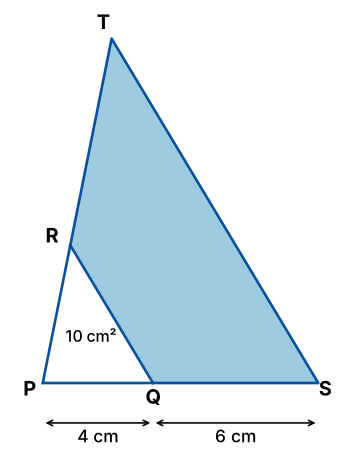
(a) Find the scale factor of the enlargement. [1 mark]
(b) Calculate the area of the shaded region . [3 marks]
Cambridge IGCSE note: using the relationship between the lengths and areas of similar shapes is Extended content in 0580.
The common wrong answer
Most students get part (a) right: the scale factor is . Part (b) is where the marks go. The working I see most often is:
“The triangle is 2.5 times bigger, so its area is 2.5 times bigger.”
The mistake is the first line. A scale factor of multiplies every length by . Area is length times length, so it is multiplied by twice. Multiplying the area by instead of is one of the errors Cambridge examiners point out on enlargement questions: candidates enlarge an area as if it were a length.
The correct working
(a) The scale factor compares distances from the centre . First find :
The scale factor is (or ).
(b) Under an enlargement with scale factor , the area of the image is times the area of the object:
The shaded region is the big triangle with the small triangle taken out:
The area of the shaded region is .
Why it works
Think of the area of a triangle as . An enlargement with scale factor makes the base times longer and the height times longer. So the area becomes
which is times the original area. The same is true for any shape, not just triangles: lengths scale by , areas by (and, for solids, volumes by ).
You can sanity-check it with a simple case. Enlarge a by square with scale factor . You get a by square, which holds four of the small squares, not two.
A quick check for this question: the shaded region should be times the small triangle, and . It matches.
How to spot it next time
- Before you use the scale factor, ask what you are scaling. Lengths use ; areas use .
- Measure the scale factor from the centre of enlargement: use and , not and . Using is a second trap in this diagram.
- When a question asks for a shaded region between an object and its image, find the image area first, then subtract the object area.