Trig Equations: When sin x Is Negative, Where Are the Two Angles?
By Adrian Wong · 29 October 2026
The question
Solve the equation
5sinx+3=2sinx+1
for 0∘≤x≤360∘. Give your answers correct to 1 decimal place. [3 marks]
Cambridge IGCSE note: solving trigonometric equations for 0∘≤x≤360∘ is Extended content in 0580.
The common wrong answer
The first step is usually fine. Collect the sinx terms on one side:
3sinx=−2⇒sinx=−32
Then the calculator gives
x=sin−1(−32)=−41.8∘
That isn’t in the range 0∘ to 360∘, so many students quietly drop the minus sign and use 41.8∘. Then they remember that sine has a second solution at 180∘ minus the angle, and write
x=41.8∘orx=180∘−41.8∘=138.2∘
Both of these are wrong. Check them on the calculator: sin41.8∘=0.667 and sin138.2∘=0.667. They solve sinx=+32, not sinx=−32. Angles between 0∘ and 180∘ always have a positive sine, so neither answer can be right.
Cambridge examiners reported this same mistake, with different numbers, as a very common incorrect answer in a recent paper. Two other slips they saw: using 180∘ minus the angle instead of 360∘ minus it, and adding the angle to 360∘, which gives an answer above 360∘.
The correct working
Rearrange to get sinx on its own:
3sinx=−2⇒sinx=−32
Find the reference angle (the acute angle) using the positive value:
sin−1(32)=41.81∘
Sine is negative in the third and fourth quadrants, so:
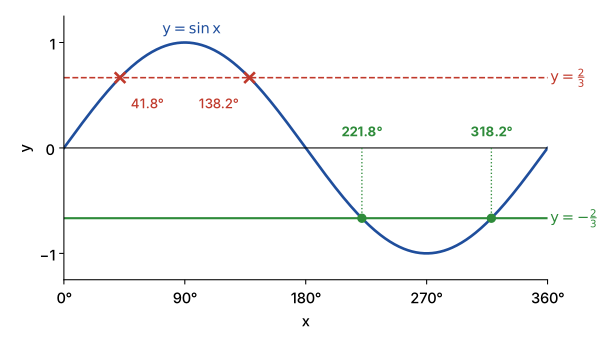
The graph shows why. The line y=−32 crosses the sine curve exactly twice between 0∘ and 360∘, and both crossings are in the half of the curve below the x-axis.
y = sin x meets y = −2/3 at 221.8° and 318.2°. The wrong answers, 41.8° and 138.2°, lie on y = 2/3.
Check: sin221.8∘=−0.667 and sin318.2∘=−0.667, and both angles are between 0∘ and 360∘. ✓
Why it works
The calculator only ever gives one angle, and for sin−1 it is always between −90∘ and 90∘. Every other solution has to come from the shape of the graph (or the quadrants), not from the calculator.
Working with the reference angle keeps the two jobs separate. The size of the number, 32, tells you the reference angle, 41.81∘. The sign tells you which quadrants to use. Sine is positive in quadrants I and II and negative in quadrants III and IV, so a negative value sends you to 180∘+41.81∘ and 360∘−41.81∘.
The −41.8∘ from the calculator isn’t useless, either. Going 41.8∘ clockwise from 0∘ lands at the same place as 360∘−41.8∘=318.2∘. That’s one of the answers; the other is in quadrant III.
How to spot it next time
If sinx is negative, both answers must be between 180∘ and 360∘. An answer below 180∘ is a warning sign.
Find the reference angle from the positive value, then use the sign to pick the quadrants: III is 180∘+angle, IV is 360∘−angle.
Put each answer back into the calculator and check you get the value you started with, sign included.
Want help with this every week?
Join an online group class with Adrian at RM50/hr and a fixed weekly time, or request a free 1-on-1 trial lesson.