
The question
A drawer contains blue pens and black pens. Mei Ling takes two pens at random from the drawer, one after the other, without replacement.
(a) Draw a tree diagram to show the possible outcomes. [2 marks]
(b) Find the probability that both pens are blue. [2 marks]
(c) Find the probability that she takes one blue pen and one black pen. [3 marks]
Give your answers as fractions in their simplest form.
Cambridge IGCSE note: combined events without replacement are Extended content in 0580. Core questions on combined events are with replacement only.
The common wrong answer
Part (b) usually goes well. Part (c) is where the marks disappear. This is the working I see most often:
The multiplication itself is right: is the probability of a blue pen first and then a black pen. But “one blue and one black” doesn’t say which comes first. Mei Ling could also take a black pen first and then a blue pen, and that is a completely separate path through the tree diagram. Leaving it out gives only half the answer.
A second slip I see often is using as the denominator both times, as if the first pen went back into the drawer:
This one has both orders, but it ignores the words “without replacement”. After the first pen is taken, only pens are left.
The correct working
(a) For the first pen there are pens: blue and black. For the second pen there are only left, and how many of each colour depends on what was taken first.
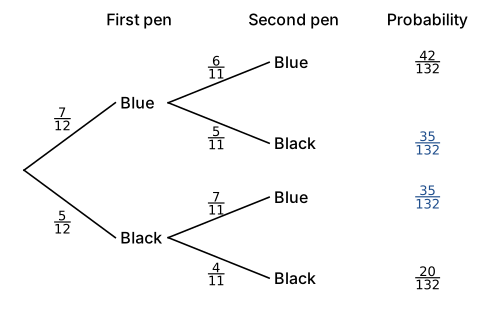
(b) Follow the blue–blue branches and multiply along them. After one blue pen is taken, blue pens are left out of :
So the probability that both are blue is .
(c) There are two paths that give one pen of each colour. Multiply along each one:
The paths can’t both happen, so add them:
So the probability of one blue and one black pen is .
Check: the last path is black–black, . All four outcomes together should make :
Why it works
Each path through a tree diagram is one complete way the experiment can turn out. You multiply along a path to get the probability of that whole path, and you add down the paths that match the event you want.
“Both blue” matches only one path, so there’s nothing to add. “One of each” matches two paths, blue-then-black and black-then-blue. The two paths happen to have the same probability here, which is why the quick method of doubling also works. But you should know why you’re doubling: it’s because there are two orders, not because of a rule to memorise.
“Without replacement” changes the second set of branches. The denominators drop from to , and the numerator for a colour drops by one only if that colour was taken first. That’s why the second pen is blue after a blue, but blue after a black.
Examiners report exactly these two errors on questions like this: not considering that the items could be chosen in either order, and using denominators as if the items were replaced.
How to spot it next time
- When the question says “one of each”, “one red and one green” or “different colours”, ask yourself: in how many orders could this happen? Each order is its own path to add.
- Read the words “with replacement” or “without replacement” before you write any fractions. Without replacement means the second denominator is one less.
- Sense-check: here more than half the pens are blue and the rest black, so getting one of each should be fairly likely. An answer of , about , is too small; is about .