
The question
A ray of light in air strikes the flat surface of a Perspex block at point . The incident ray makes an angle of 40° with the surface of the block. Inside the block, the refracted ray makes an angle of 59° with the surface.
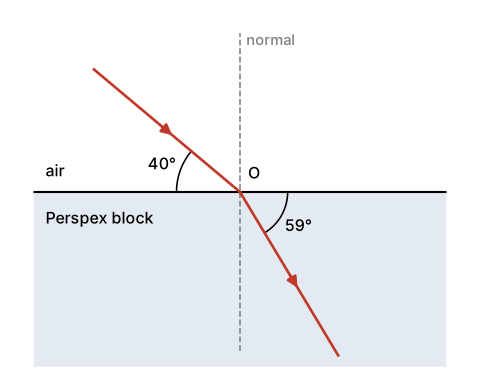
(a) State the angle of incidence and the angle of refraction. [2 marks]
(b) Calculate the refractive index of the Perspex. [2 marks]
(c) Calculate the speed of light in the Perspex. The speed of light in air is . [2 marks]
Cambridge IGCSE note: refractive index, and the speed ratio are Extended (Supplement) content in 0625. Core students still need to know that the angles of incidence and refraction are measured from the normal.
The common wrong answer
Most students remember and put in the two angles they can see in the diagram:
The formula is right, but the angles are wrong. In , the angle of incidence and the angle of refraction are measured from the normal, the dashed line at 90° to the surface. The 40° and 59° in the diagram are measured from the surface.
There is also a built-in alarm here. Light going from air into Perspex slows down, so the refractive index must be greater than 1. An answer of 0.75 would mean light travels faster in Perspex than in air, which is impossible. Cambridge examiner reports regularly mention candidates who use the wrong angle in refractive index questions, for example subtracting from 180° instead of 90°, or using a cosine instead of a sine.
The correct working
(a) The normal is at 90° to the surface, so each angle from the normal is 90° minus the angle from the surface:
So the angle of incidence is 50° and the angle of refraction is 31°.
Quick check: the ray bends towards the normal (31° is smaller than 50°), which is what should happen when light enters a denser medium.
(b) Use the angles from the normal:
So the refractive index is 1.49 (3 s.f.). It is greater than 1, as it must be.
(c) The refractive index is also the ratio of the speed of light in air to the speed of light in the Perspex:
So the speed of light in the Perspex is (3 s.f.). Keep the unrounded value of from (b) in your calculator. If you divide by the rounded 1.49 instead, you get , which is slightly off.
Why it works
The normal is the reference line for everything in reflection and refraction. When light crosses a boundary at an angle, it changes direction because it changes speed, and Snell’s law describes that change using angles from the normal. A ray travelling along the normal (angle of incidence 0°) goes straight through without bending, which only makes sense if angles are measured from the normal.
Measuring from the surface swaps sines for cosines, because . That is why the surface angles give the wrong ratio, and here even a value below 1.
How to spot it next time
- Before using , find the normal on the diagram (draw it if it isn’t there) and check that both angles are measured from it. If an angle is from the surface, subtract it from 90°.
- Light entering glass, Perspex or water from air bends towards the normal, so must be smaller than .
- Your refractive index must be greater than 1. If you get a value below 1, you have almost certainly used the surface angles.