
The question
A 6 Ω resistor and a 3 Ω resistor are connected in parallel across a 12 V battery of negligible internal resistance.
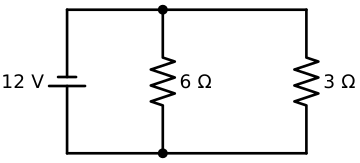
(a) Calculate the effective resistance of the circuit. [2 marks]
(b) Calculate the current supplied by the battery. [2 marks]
Cambridge IGCSE note: calculating the combined resistance of parallel resistors is Extended (Supplement) content in 0625. Core students only need to know that it is less than either resistor.
The common wrong answer
There are two wrong answers I see again and again.
Trap 1: adding them. Students write . That is the rule for resistors in series, not parallel. It gives a battery current of , which is wrong.
Trap 2: forgetting to flip. Students use the right formula but stop one line too early:
The sum gives , not . Writing 0.5 Ω leads to a battery current of 24 A, which is wrong by a factor of four.
A quick sense check catches both: in parallel, the effective resistance is always smaller than the smallest resistor. Here that means less than 3 Ω, so 9 Ω fails straight away. But 0.5 Ω passes this check, which makes Trap 2 the more dangerous one: the sense check won’t save you, so you must remember the final flip.
The correct working
(a) For resistors in parallel:
Now flip both sides:
For exactly two resistors you can also use “product over sum”:
Effective resistance = 2 Ω.
(b) Using :
Current supplied by the battery = 6 A.
You can check this a second way. Each resistor has the full 12 V across it, because they are in parallel:
Why it works
Each resistor in parallel gives the current another path from one side of the battery to the other. More paths means it is easier for current to flow, so the combined resistance must be less than either resistor on its own.
That’s why we add the reciprocals. measures how easily current flows through a resistor (its conductance), and in parallel the “ease of flow” of each path adds up:
The total ease of flow is , so the resistance itself is the reciprocal of that: 2 Ω. Adding the resistances directly () is only right in series, where the current must pass through one resistor and then the other.
How to spot it next time
- Parallel answer < smallest resistor. If your effective resistance is bigger than any single resistor in parallel, you have used the series rule.
- Label the line . When you add the reciprocals, write "" at the start of the line, so you see that one more step is needed to get .
- Check with the branch currents. In parallel each branch has the same voltage, so work out each branch current and add them. If the total doesn’t match , something has gone wrong.