
The question
The function is defined by
for all real values of .
(a) Find an expression for . [2 marks]
(b) Find the value of . [1 mark]
(c) Solve the equation . [2 marks]
The common wrong answer
Many students try to find the inverse by “undoing” each step of in their head. They read as: multiply by 3, subtract 4, divide by 2. Then they undo each step in the same order: divide by 3, add 4, multiply by 2.
Everything after that is built on this wrong inverse:
and for part (c):
The mistake is the order. Undoing a function is like taking off your shoes and socks: the last thing you put on is the first thing you take off. The last step of is “divide by 2”, so the first step of must be “multiply by 2”. The Cambridge 0606 examiner report for June 2024 noted this in many responses: an incorrect order of operations was used to find the inverse function.
A one-line check catches it. If really were , then would have to be 7. But
which is not 7, so the “inverse” is wrong.
The correct working
(a) Write and rearrange to make the subject. Each line undoes the last operation still left on the right-hand side.
So . Write it with as the variable:
The answer is .
Check: . It works.
(b) Substitute 7:
So . Check: . Correct.
(c) Set the two expressions equal and multiply both sides by 6 to clear the fractions:
So . Check: and . Both give 4.
Why it works
A function is a machine that does steps in order. Here takes , multiplies by 3, subtracts 4, then divides by 2. To get back to , you have to walk the same path backwards: multiply by 2, add 4, then divide by 3. That is exactly .
Rearranging does this for you automatically, because you always peel off the outermost operation first. That is why it is safer than doing it in your head.
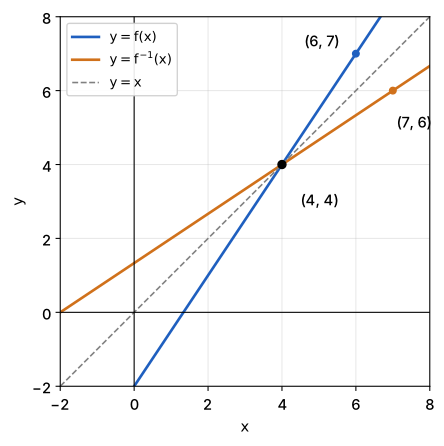
The graph shows the second idea used in part (c). The inverse swaps every input and output, so on becomes on . Swapping coordinates is a reflection in . For an increasing function like this one, and can only meet on the line , so you could also have solved part (c) with , which gives , so .
The wrong inverse fails this test too: it meets at , which is not on .
How to spot it next time
- Find an inverse by writing and rearranging line by line, not by reversing steps in your head.
- Check your answer with one number: pick a value such as , work out , and make sure your gives 6 back.
- In “solve ” questions, your answer should satisfy as well. If it doesn’t, recheck your inverse.