Skip to content
TopScorerPlus
← All question bank
IGCSE · Year 10–11SPM · Form 4Add Maths Standard

Simultaneous Equations: Substitute Back Into the Linear Equation

By Adrian Wong · 7 November 2026

The question

The straight line x−2y=1x - 2y = 1 meets the curve x2+y2=13x^2 + y^2 = 13 at the points AA and BB.

(a) Find the coordinates of AA and BB. [5 marks]

(b) Find the length of ABAB, giving your answer in the form p5q\dfrac{p\sqrt{5}}{q}, where pp and qq are integers. [2 marks]

The common wrong answer

The start is usually fine. Make xx the subject of the linear equation, x=2y+1x = 2y + 1, and substitute into the curve:

(2y+1)2+y2=13(2y + 1)^2 + y^2 = 13 4y2+4y+1+y2=135y2+4y−12=0(y+2)(5y−6)=0\begin{aligned} 4y^2 + 4y + 1 + y^2 &= 13 \\ 5y^2 + 4y - 12 &= 0 \\ (y + 2)(5y - 6) &= 0 \end{aligned}

So y=−2y = -2 or y=65y = \frac{6}{5}. Then comes the slip: to find xx, the student substitutes each yy back into the curve, x2+y2=13x^2 + y^2 = 13:

y=−2:x2=13−4=9⇒x=±3y = -2: \quad x^2 = 13 - 4 = 9 \quad\Rightarrow\quad x = \pm 3 y=65:x2=13−3625=28925⇒x=±175y = \frac{6}{5}: \quad x^2 = 13 - \frac{36}{25} = \frac{289}{25} \quad\Rightarrow\quad x = \pm\frac{17}{5}

The answer then lists four points: (3,−2)(3, -2), (−3,−2)(-3, -2), (175,65)\left(\frac{17}{5}, \frac{6}{5}\right) and (−175,65)\left(-\frac{17}{5}, \frac{6}{5}\right).

A straight line can cross this curve at most twice, so four points can’t be right. Two of them lie on the curve but not on the line. Test (3,−2)(3, -2) in the line: 3−2(−2)=73 - 2(-2) = 7, not 11. Squaring threw away the sign of xx, and the curve alone can’t tell you which sign belongs with which yy. Part (b) then goes wrong too: a student who picks (3,−2)(3, -2) and (175,65)\left(\frac{17}{5}, \frac{6}{5}\right) gets AB=2655≈3.22AB = \frac{2\sqrt{65}}{5} \approx 3.22, which isn’t even in the form asked for.

A Cambridge examiner report on a similar question noted that, after solving the quadratic correctly, some candidates forgot to substitute back to find the other values. Substituting back is where the marks go, whether the step is skipped or done into the wrong equation.

The correct working

(a) Use the linear equation to make one letter the subject. x=2y+1x = 2y + 1 avoids fractions, so it is the easier choice:

x=2y+1x = 2y + 1

Substitute into the curve and solve the quadratic in yy:

(2y+1)2+y2=135y2+4y−12=0(y+2)(5y−6)=0\begin{aligned} (2y + 1)^2 + y^2 &= 13 \\ 5y^2 + 4y - 12 &= 0 \\ (y + 2)(5y - 6) &= 0 \end{aligned} y=−2ory=65y = -2 \quad\text{or}\quad y = \frac{6}{5}

Now find each matching xx from the linear equation x=2y+1x = 2y + 1, which gives exactly one xx for each yy:

y=−2:x=2(−2)+1=−3y = -2: \quad x = 2(-2) + 1 = -3 y=65:x=2(65)+1=175y = \frac{6}{5}: \quad x = 2\left(\frac{6}{5}\right) + 1 = \frac{17}{5}

So the points are A(−3,−2)A(-3, -2) and B(175,65)B\left(\frac{17}{5}, \frac{6}{5}\right) (either way round).

Check BB in both equations: 175−2(65)=55=1\frac{17}{5} - 2\left(\frac{6}{5}\right) = \frac{5}{5} = 1 ✓ and 28925+3625=32525=13\frac{289}{25} + \frac{36}{25} = \frac{325}{25} = 13 ✓.

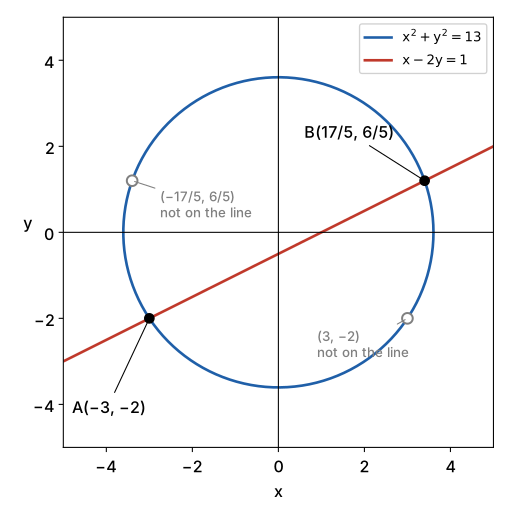
The circle x² + y² = 13 and the straight line x − 2y = 1 on the same axes. The line crosses the circle at exactly two points, A(−3, −2) and B(17/5, 6/5), shown as solid dots. Two hollow grey dots at (3, −2) and (−17/5, 6/5) lie on the circle but not on the line, and are labelled as not on the line.
The line meets the curve at only A and B. The two grey points come from substituting into the curve instead of the line.

(b) Use the distance formula with A(−3,−2)A(-3, -2) and B(175,65)B\left(\frac{17}{5}, \frac{6}{5}\right):

Δx=175−(−3)=325Δy=65−(−2)=165\begin{aligned} \Delta x &= \frac{17}{5} - (-3) = \frac{32}{5} \\ \Delta y &= \frac{6}{5} - (-2) = \frac{16}{5} \end{aligned} AB=(325)2+(165)2=1024+25625=12805AB = \sqrt{\left(\frac{32}{5}\right)^2 + \left(\frac{16}{5}\right)^2} = \sqrt{\frac{1024 + 256}{25}} = \frac{\sqrt{1280}}{5}

Since 1280=256×51280 = 256 \times 5, 1280=165\sqrt{1280} = 16\sqrt{5}, so

AB=1655≈7.16AB = \frac{16\sqrt{5}}{5} \approx 7.16

The answer is AB=1655AB = \dfrac{16\sqrt{5}}{5}.

Why it works

Each solution of a pair of simultaneous equations is a pair of values: a point that lies on both graphs. Once you know yy, the matching xx must satisfy both equations, so you can find it from either one in principle. But the curve contains x2x^2, and squaring hides the sign. For y=−2y = -2 it says x2=9x^2 = 9, which is true at x=3x = 3 and at x=−3x = -3, because the circle passes through both. Only one of those is also on the line.

The linear equation has no such problem. It gives exactly one xx for each yy, and that xx is automatically on the line. Since the yy came from solving the combined equation, the point is on the curve as well.

The number of points also follows from the algebra. Eliminating xx gave a quadratic in yy, which has at most two roots. Two roots means two points, so any answer with more than two points has gone wrong somewhere.

How to spot it next time

Want help with this every week?

Join an online group class with Adrian at RM50/hr and a fixed weekly time, or request a free 1-on-1 trial lesson.