IGCSE · Year 10–11SPM · Form 4Add Maths Challenging
Linear Law: The Intercept Is lg a, Not a
By Adrian Wong · 3 November 2026
The question
The variables x and y are related by the equation
y=axn
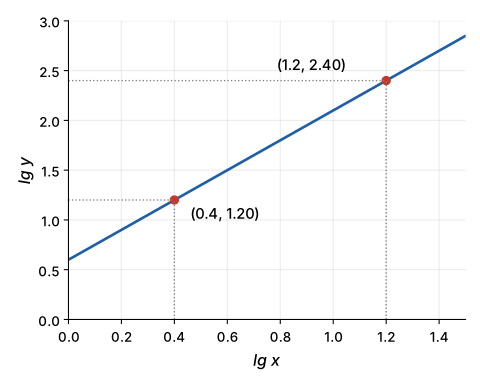
where a and n are constants. When lgy is plotted against lgx, a straight line is obtained. The line passes through the points (0.4,1.20) and (1.2,2.40), as shown in the diagram. (lg means log10.)
The graph of lg y against lg x is a straight line through (0.4, 1.20) and (1.2, 2.40).
(a) Find the value of n and the value of a, giving a to 3 significant figures. [4 marks]
(b) Find the value of y when x=5. [2 marks]
(c) Find the value of x when y=100. [2 marks]
The common wrong answer
Most students get the gradient right:
n=1.2−0.42.40−1.20=0.81.20=1.5
They also find the intercept correctly. Using the point (0.4,1.20) in Y=mX+c:
1.20=1.5(0.4)+c⇒c=0.6
Then comes the slip. They see that the intercept “goes with” a and write a=0.6, so the equation becomes y=0.6x1.5. Everything after that is wrong:
The mistake is forgetting what is on the vertical axis. The graph is of lgy, not y, so its intercept is lga, not a. The Cambridge 0606 examiner report for June 2024 described the same problem on a log graph question: more commonly than a correct equation, candidates wrote "y=" where the equation of the line needed "lny=". Once the log is dropped from one side, the constant comes out wrong.
You can catch it with a quick check. If a really were 0.6, the intercept would be lg0.6=−0.222. That is below the origin, but the line crosses the axis above it.
The correct working
(a) Take logs of both sides of y=axn and use the log laws:
lgy=lga+nlgx
Rearrange it into the form Y=mX+c:
Ylgy=nXlgx+clga
So the gradient is n and the intercept on the lgy axis is lga.
Gradient:
n=1.2−0.42.40−1.20=0.81.20=1.5
Intercept, using the point (0.4,1.20):
1.20lga=1.5(0.4)+lga=1.20−0.6=0.6
Undo the log to get a:
a=100.6=3.981…
So n=1.5 and a=3.98 (3 s.f.), which gives y=3.98x1.5.
Check with the other point: 1.5(1.2)+0.6=2.40. It lies on the line.
(b) Use the straight-line equation with x=5, so lgx=lg5=0.6990:
lgyy=1.5(0.6990)+0.6=1.6485=101.6485=44.5
So y=44.5 (3 s.f.). You get the same from y=3.98×51.5=3.98×11.18=44.5.
(c) When y=100, lgy=lg100=2:
2lgxx=1.5lgx+0.6=1.51.4=0.9333=100.9333=8.58
So x=8.58 (3 s.f.). Check: 3.981×8.5771.5=100.
Why it works
Taking logs turns a curve into a straight line, but it changes what the axes measure. Every point on this graph is (lgx,lgy), not (x,y). The point (1.2,2.40), for example, means x=101.2≈15.8 and y=102.40≈251.
The intercept is the value of lgy when lgx=0, that is, when x=1. Put x=1 into y=axn and you get y=a, so the intercept is lga. To get a itself you have to undo the log: a=10intercept.
The gradient is different. The power n is the coefficient of lgx, so it comes straight off the graph with no log to undo. That is why students who get n right can still get a wrong.
In parts (b) and (c) it is often safest to stay with the straight-line equation, lgy=1.5lgx+0.6. It uses the exact intercept, so you avoid carrying the rounded a=3.98.
How to spot it next time
Before reading anything off the graph, write the log form with each part labelled: lgy=nlgx+lga. Whatever sits in the c position is what the intercept equals.
If the vertical axis is lgy, the intercept is a log. Raise 10 to that power to get the constant. If the axis is lny, use e instead.
Check your final equation with a point from the graph. Convert it back first: the point (0.4,1.20) means x=100.4 and y=101.20.
Want help with this every week?
Join an online group class with Adrian at RM50/hr and a fixed weekly time, or request a free 1-on-1 trial lesson.